Marble Mountains or Son Tra: Choosing a Da Nang Half Day
Independent planning guide · How we use sources · Affiliate disclosure · Before you book ↓
If you have one free half day in Da Nang, choose the experience first. Marble Mountains is a stronger starting point for a focused visit built around caves, temples and a defined sightseeing area. Son Tra suits a plan built around named peninsula stops and coastal scenery. The useful Marble Mountains vs Son Tra comparison is about the route you will actually follow, your walking tolerance and the time you must return.

In this guide
- Understand the two kinds of visit
- Compare your actual half-day options
- Make walking demands specific
- Check Son Tra road rules without overgeneralising
- Build the half day backwards from your return
- Choose a pace, not just a transport option
- Decide when to change the plan
- A request you can send to an operator
- Frequently asked questions
Neither destination name tells you the effort involved. A short list of stops can still include steps, waiting, transfers or paths you do not want to attempt. Before choosing, ask what the proposed half day contains and what can be left out without disrupting everyone else.
Understand the two kinds of visit
The official Da Nang introduction to Marble Mountains describes cave and pagoda sights at Thuy Son and notes stone-step access as well as a separately ticketed elevator. An elevator journey should not be interpreted as confirmation that every cave, viewpoint or connecting path is step-free. Source checked on 23 October 2026.
For Son Tra, name the individual stops instead of booking an undefined “peninsula tour.” The official Son Tra visitor information covers places with different access demands, including Linh Ung Pagoda and Ban Co Peak; it describes a steep stair approach at the latter. It also publishes rules for specific designated roads. Those details are reasons to ask about your precise route, not assume a single access rule applies everywhere.
Choose a main priority
Complete this sentence: “By the end of the outing, I would most like to have experienced…” Your answer might be a cave interior, temple architecture, an ocean-facing stop or a relaxed cultural visit. Use that answer to eliminate a route whose main appeal is different.
Travellers often try to solve limited time by adding places. A more useful first step is choosing one memorable focus, then allowing for arrival, walking, a break and the return. You can add another stop only after that basic plan fits comfortably.
Compare your actual half-day options
| Decision | Marble Mountains: ask about | Son Tra: ask about |
|---|---|---|
| Main experience | Exact caves, temples and viewpoints | Exact peninsula stops and route |
| Walking | Steps and surfaces on the selected circuit | Walking from each vehicle stop |
| Access | What the elevator does and does not cover | Road permission and vehicle suitability |
| Pace | Shortened visit and suitable waiting point | Stops that can be omitted or shortened |
| Weather | Conditions on exposed paths and steps | Road, visibility and stop conditions |
| Return | Collection point and planned departure | Final stop and return arrangement |
Treat this as a question sheet rather than a scorecard. One traveller's acceptable staircase may be another traveller's main obstacle. A panoramic stop may feel worthwhile to one person and unnecessary to someone who would rather spend longer in a temple courtyard.
Make walking demands specific
Ask about the parts of the visit that matter to your group. “Is it easy?” invites a subjective answer. “Which stops involve steps, and can we omit those while staying with the same driver?” gives the person arranging the outing something concrete to address.
For Marble Mountains, ask the operator to trace the proposed route. Identify the arrival point, any elevator segment, stairs between the chosen sights and the exit. If the complete route is unsuitable, ask for a shorter version before booking.
For Son Tra, request the walking requirement at each named stop. A vehicle-based outing can still include an uphill approach or uneven path. If someone wishes to stay near the vehicle, confirm that a suitable waiting arrangement is possible at that specific stop.
Plan for mixed walking tolerances
Choose a shared core that the whole group wants, then discuss optional additions. Agree who will accompany anyone who rests and where everyone will meet again. Avoid creating a plan that depends on a less mobile traveller waiting without knowing the next step.
If particular access requirements determine whether you can visit, seek current, specific confirmation directly from the site or the operator. Photographs and broad accessibility labels cannot establish the suitability of every part of a route for an individual visitor.
Check Son Tra road rules without overgeneralising
The official visitor page lists three controlled routes with checkpoints, restrictions on automatic scooters and larger buses, and a one-way section. It also distinguishes those routes from other branch roads and publishes seasonal visiting windows for the controlled routes. Check the current official route notice and your operator's proposed journey before departure.
Do not turn these route-specific conditions into a claim that all of Son Tra has identical vehicle access. Ask which roads your outing uses, whether your vehicle is allowed on those roads and what the driver will do if current instructions change.
A map pin showing a viewpoint does not establish that your vehicle may reach it. Save the exact route confirmation, but follow signs and checkpoint directions on the day. A suggested itinerary is inspiration; it does not override local access controls.
Build the half day backwards from your return
Start with the time you need to be back, including any hotel checkout, meeting or onward journey. Then allow for the return transfer and a margin that makes sense for your commitment. Ask the operator what sightseeing time remains after those elements.
Next, place your main stop and a realistic break. Only then consider an additional sight. This method avoids a common planning mistake: counting every available hour as sightseeing time and leaving the journey home as an afterthought.
If your return deadline is strict, tell the driver or guide before booking. A private arrangement may allow a different sequence, but changes must still be agreed. A shared tour operates around the group's itinerary and cannot be assumed to accommodate one guest's separate appointment.
Find more ideas for matching sightseeing with your stay at VisitVietnam.click.
Choose a pace, not just a transport option
A longer list does not automatically create a better half day. Ask whether the quote includes time for walking slowly, making photographs and sitting down. Discuss optional shopping stops separately so they do not unexpectedly use the time you intended for sightseeing.
For a temple-focused visit, allow attention for the setting rather than treating every stop as a photograph. Follow the dress and behaviour instructions posted at the places you enter. If the outing is primarily scenic, decide whether one sustained stop is more appealing than several brief arrivals.
Also clarify the role of the person accompanying you. A driver, an escort and a guide may provide different services. Ask where assistance begins, whether explanations are included and how you will communicate when the vehicle is parked away from you.
Decide when to change the plan
Check current weather and local operating information before setting out. Ask whether the planned route is appropriate under the actual conditions, and accept a shorter route or postponement when instructed. Do not use a season label as a guarantee about your particular morning or afternoon.
Agree in advance which part of the plan can change. For example, your hypothetical group might keep a suitable principal stop and omit a further viewpoint if conditions deteriorate. This is a planning example, not a statement that any named site remains open in bad weather.
Bring what your group needs for the confirmed outing and ask about carrying arrangements. Keep the day manageable: enough time to take a break, an agreed collection point and a clear way to contact your driver are more useful than a rushed extra stop.
A request you can send to an operator
Use this message when comparing two proposed outings:
We have one half day available and must return by our stated time. Please send the exact stops, roads and walking route. Which sections have stairs or uneven surfaces? Please explain vehicle access, any elevator arrangement, optional stops, the collection point and how the route changes if current conditions make a section unsuitable.
Add the details that would alter your decision: a visitor avoiding stairs, a child needing breaks, or a preference for a guided cultural visit. Ask for a revised route if the original plan includes something your group cannot comfortably do.
Frequently asked questions
Which choice fits a shorter outing?
Compare one focused Marble Mountains circuit with one clearly named Son Tra route. The shorter option depends on your hotel, the selected stops and current access. Request a complete plan including travel and walking before deciding; destination labels alone cannot establish the time required.
Is the Marble Mountains elevator enough for visitors avoiding stairs?
It addresses a particular part of access, not every movement around the site. Ask exactly which sights can be reached on the proposed route and which remaining sections involve steps. Decide from that information rather than assuming that an elevator makes the entire visit step-free.
Can we combine Marble Mountains and Son Tra in one half day?
Ask for a written itinerary and assess what is lost at each place. Combining them may leave little time for the experience you value most. With a limited window, choosing one satisfying visit can be more useful than aiming to tick both destination names.
Choose the outing whose actual route fits your interests and pace, with room for the return. Build your Da Nang plan with VisitVietnam.click and use confirmed local information to settle the final details.
Reference links
Sources checked 2026-10-23. Reconfirm service-specific arrangements for your travel dates.
Save the planning cards
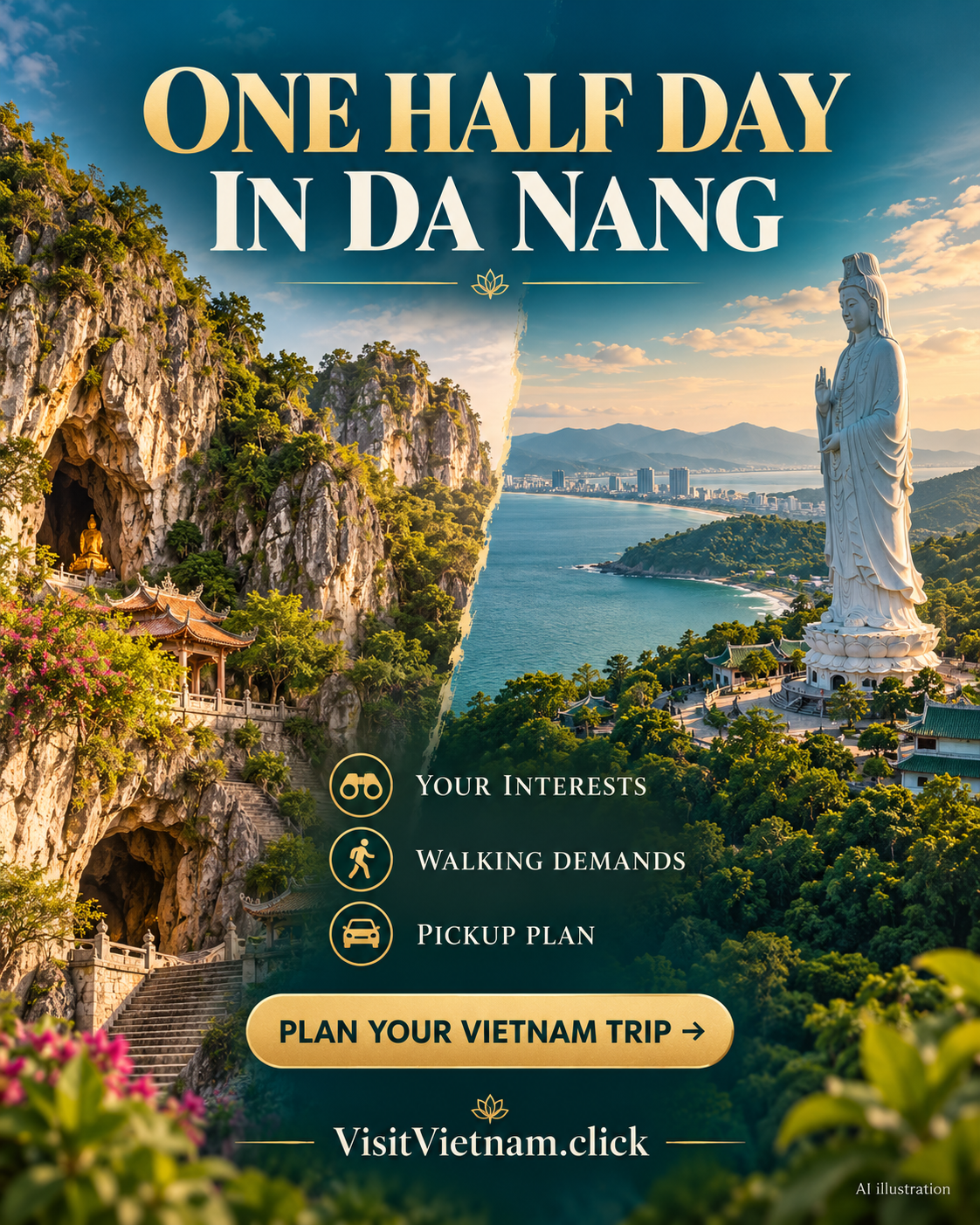


AI-generated illustrations for this guide.
Questions & travel notes
Ask about this guide or share a useful travel detail. Comments are reviewed before publication. This discussion is hosted by VisitVietnam, independently of Facebook.