Vietnam Day Trains: Soft Seat or Sleeper for Your Route?
Independent planning guide · How we use sources · Affiliate disclosure · Before you book ↓
For a daytime train in Vietnam, choose between a seat and a berth by looking at the actual service, the amount of rest you want and the people travelling with you. A seat can suit a journey you want to spend sitting and looking outside. A berth may be more useful if lying down is an important part of your plan. Neither label alone tells you the complete experience.

In this guide
- Start with your exact departure
- Compare sitting, resting and sharing space
- A berth is an allocated place, not necessarily a private cabin
- Be precise about comfort and facilities
- Build a decision around your travel day
- Ask the seller a useful question
- Plan the arrival before deciding
- Frequently asked questions
- Sources checked — 23 October 2026
The most useful Vietnam day train seat versus sleeper comparison starts after you choose the route and travel date. Check what is being sold on that departure, then compare the specific carriage, allocated place and conditions. A general train guide cannot confirm that both options are available for your journey.
Start with your exact departure
Write down the origin station, destination station, date and train identifier before comparing accommodation. Two services between the same cities may differ in timing, stopping pattern and available places. Do not compare a seat on one train with a berth on another without acknowledging those differences.
The official railway fare-lookup page distinguishes soft-seat categories and several berth categories, including four-berth and six-berth descriptions. Its class legend is useful for understanding labels, but does not establish availability on every service. See the Vietnam Railways fare lookup, checked 23 October 2026.
If a seller uses English marketing names, compare them with the issued ticket description. Ask which operator and carriage the purchase covers, especially when a booking page shows several products for the same route. Keep a screenshot of the selected option alongside the confirmation.
Check the time you will actually spend travelling
Use the departure and arrival shown for the chosen service. Add the station transfer at each end and the time you need before boarding. A journey advertised as daytime can still begin early or end after your hotel reception's usual arrangements.
Avoid choosing a berth solely because the route looks long on a map. Equally, do not choose a seat solely because the train arrives before evening. Your energy level, the activities before departure and your plans after arrival can matter as much as the number of hours aboard.
Compare sitting, resting and sharing space
Think about what you want to do during the journey. If you plan to read, talk and look outside, a seated arrangement may fit that intention. If you need a chance to lie down, check the berth option and its exact allocation rather than assuming an empty cabin will be available.
| Your priority | What to ask about a seat | What to ask about a berth |
|---|---|---|
| Resting | Seat type and any supported reclining position | Berth position, access and bedding details |
| Travelling together | Whether places are adjacent or separated | Which places are in the same compartment |
| Looking outside | Window location and any known obstruction | How the allocated berth relates to the window |
| Moving around | Aisle access and the space around your place | The route from the berth to the corridor |
| Luggage | Permitted size, storage position and handling | Storage position and access while the berth is used |
| Budget | Final total and applicable terms | Final total and applicable terms |
These are questions to confirm, not promises about every carriage. If a detail is important enough to change your decision, ask for a service-specific answer before paying.
A berth is an allocated place, not necessarily a private cabin
Read the unit being sold. A photograph of a compartment does not necessarily mean the displayed price buys the whole space. Check whether you are purchasing one berth, several berths or an explicitly described private arrangement.
For a group, list the number of travellers and the exact places you want. Ask whether those places can be confirmed together on the same departure. A note saying that you prefer one compartment is different from ticket allocation showing that the request has been fulfilled.
Consider access as well as privacy. If a traveller cannot comfortably climb, do not assume the seller will be able to swap the allocated berth later. Confirm an appropriate place before committing, and ask how any assistance would work for that particular journey.
For the seated option, check adjacency with the same care. “Same carriage” and “next to each other” describe different outcomes. Examine the allocation rather than relying on the order in which passenger names appear in a confirmation email.
Be precise about comfort and facilities
Ask about the features that matter to you without turning the conversation into a long generic checklist. For example, if you need to charge a device, ask whether that facility is available at your selected place on the actual carriage. Do not treat a promotional photo as confirmation.
If seat recline, bedding or carriage layout influences your decision, request the current product description or a relevant image. A broad category name is a starting point, and not a guarantee of a particular refurbishment, finish or arrangement.
Vietnam's official tourism transport guide discusses both soft seats and sleeper accommodation as rail options. Use that overview for context, then verify the service itself through the railway or your seller. Source: Vietnam Tourism, transport within Vietnam, checked 23 October 2026.
Keep expectations realistic about rest in a shared travelling environment. Booking a berth gives you the place specified on the ticket; it does not establish how quiet the whole journey will be. If your next day depends on uninterrupted sleep, reconsider the complete itinerary as well as the carriage choice.
Build a decision around your travel day
Take two hypothetical travellers using the same daytime service. One has a relaxed morning, wants to look outside and has no demanding plan after arrival. The other starts the day after an overnight connection and wants an opportunity to lie down. Their priorities can lead to different choices even when the route and price difference are identical.
Now add a family or group. The deciding issue may be confirmed places together rather than the category that sounds most comfortable. Compare the available allocation, the needs of each traveller and the cost for the whole party.
Do not invent a fixed rule such as choosing a sleeper whenever a journey exceeds a particular number of hours. Instead, identify what would make you regret the booking: being unable to lie down, climbing to an unsuitable berth, being separated from a companion or paying for a feature you did not need.
Use a short comparison note
For each real option, record the following on one page:
- Train identifier, date, stations and published timing.
- Carriage description and specific place allocation.
- Number of travellers included in the quote.
- Final cost and the important change or cancellation conditions.
- Any facility or arrangement confirmed by the seller.
- The main reason this option fits your particular day.
This makes the choice easier to discuss with a travel companion. It also prevents a low headline price from distracting you from an unsuitable departure or an incomplete allocation.
Ask the seller a useful question
Here is an original message you can adapt:
Hello, we are comparing the seat and berth options on train [identifier], from [station] to [station] on [date], for [number] travellers. Please confirm the exact carriage category, which places would be allocated together, and whether the berth quote is per person or for a private arrangement. Our main requirement is [specific need]. Please also share the total price and applicable booking terms.
Keep the answer with the booking record. Once tickets are issued, check that the confirmed carriage and places match what you accepted. If an answer remains unclear, ask one follow-up question about the point that would change your decision.
Plan the arrival before deciding
The train is only one part of the day. Check how you will reach your accommodation, when you can enter the room and whether you have planned too much after arrival. A berth does not remove the need for a sensible arrival plan, and a seat does not automatically make the day tiring.
Keep essential items accessible in a small bag so you do not have to open your main luggage repeatedly. Confirm luggage rules for the chosen service rather than borrowing a size or weight limit from an unrelated route.
If your dates are flexible, compare complete journeys on different departures. A service with a more convenient arrival can be more valuable to you than a more expensive accommodation category on a badly timed train. Make the final choice using confirmed information for each option.
Frequently asked questions
Does every Vietnam daytime train offer soft seats and sleepers?
Do not assume that it does. Check the accommodation being sold on your chosen date and service. The railway's category legend explains different labels across its system; it does not mean every train contains every category. If one option is absent, ask whether it is unavailable on that service or simply unavailable for your booking.
Can you book a berth for a daytime journey?
Check whether a berth is offered for your exact segment and departure. If it is, confirm the unit being sold, the allocated position and the terms. Do not assume that a daytime berth booking includes a private compartment or that a seat ticket lets you use an unoccupied berth.
How should groups check seat or berth allocation?
Ask for the specific places and how they relate to one another before payment when possible. After issuance, review each ticket together. Confirm whether everyone is adjacent, in the same compartment or merely in the same carriage. If being together is essential, make it a condition of your booking decision.
Choose a rail journey that fits your trip: explore more practical Vietnam travel planning at VisitVietnam.click.
Sources checked — 23 October 2026
- Vietnam Railways official fare lookup and category legend. Supports the limited explanation that different soft-seat and berth categories exist; not a live availability check for an unspecified journey.
- Vietnam Tourism — Transport within Vietnam. Used only for the general context of seated and sleeper rail options; no timetable, fare, child fare or universal carriage-facility claim is taken from it.
Save the planning cards
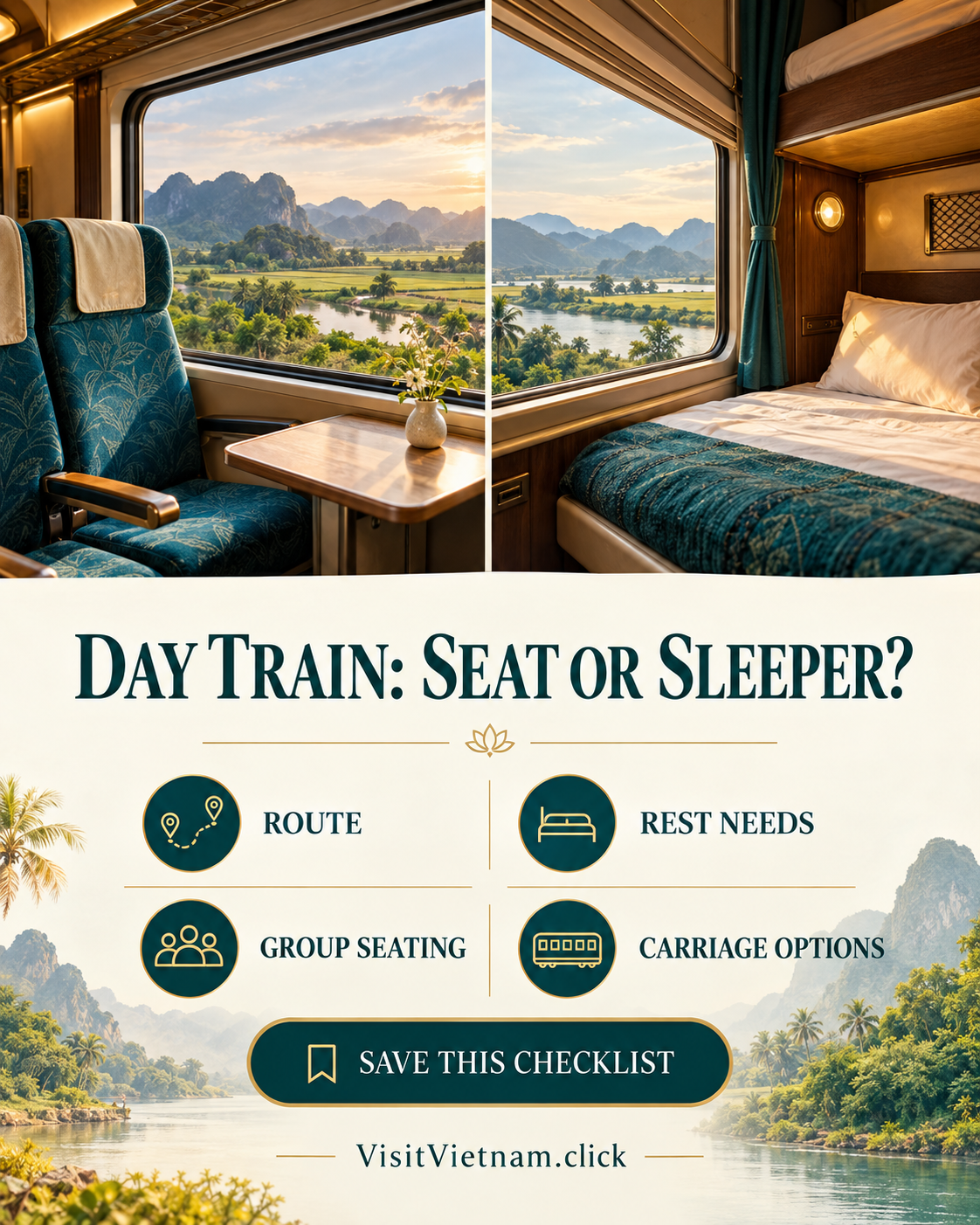

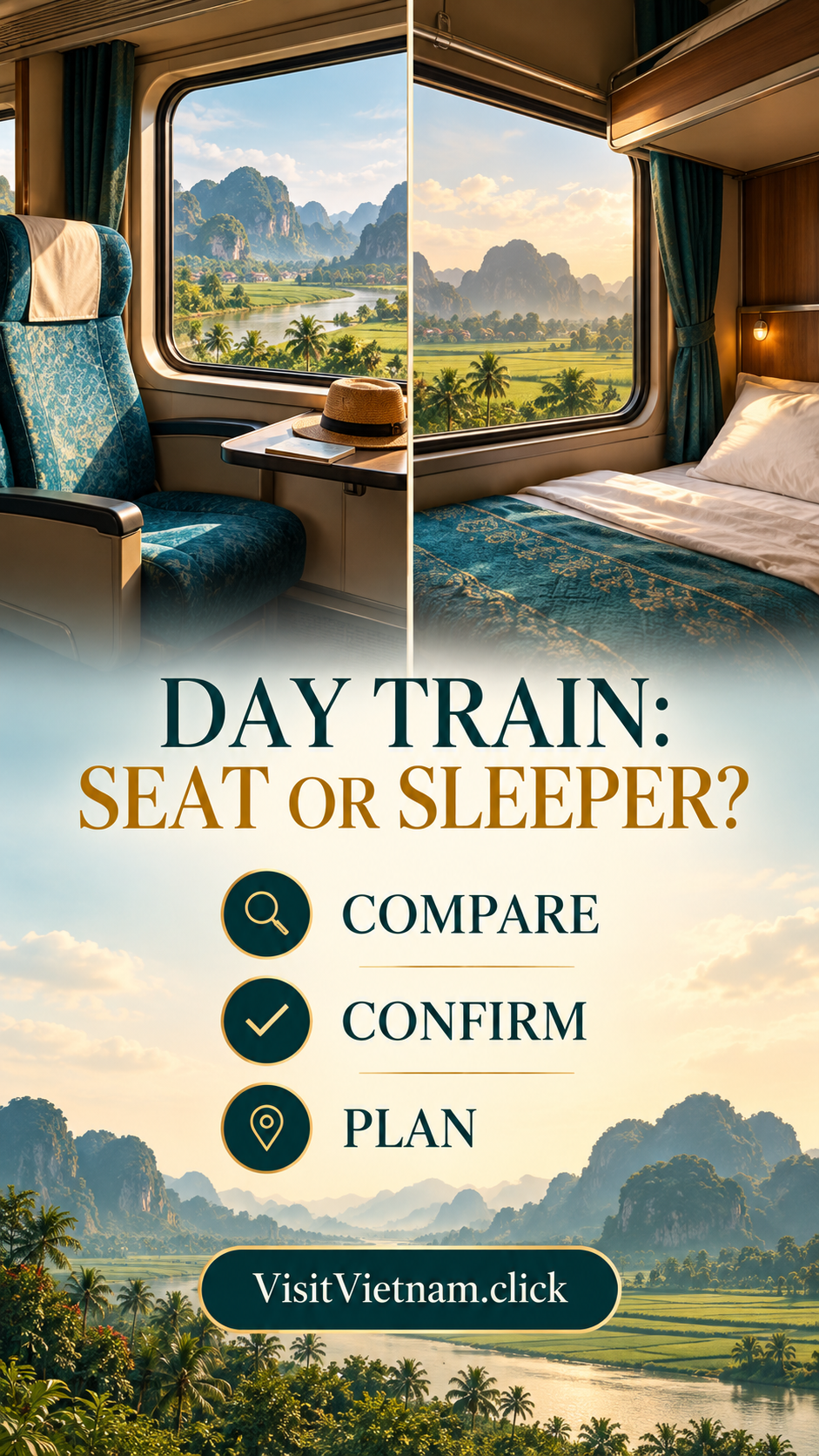
AI-generated illustrations for this guide.
Questions & travel notes
Ask about this guide or share a useful travel detail. Comments are reviewed before publication. This discussion is hosted by VisitVietnam, independently of Facebook.